
NEWSLETTER#01
SEPT 2026
Funded by
the European Union
The SimuLingua first Newsletter
- Publication Date
We are delighted to present the latest news and updates from the SimuLingua project covering the first four months of its implementation.
Content
We are delighted to present the latest news and updates from the SimuLingua project covering the first four months of its implementation.
The project will run for 48 months (4 years), and we plan to publish 12 newsletters during this time.
The project's mission is to develop an open, multimodal Scientific Foundation Model (SciFM) that unifies text, structures, and simulation data, thereby accelerating discovery cycles by over 50%.
Project at a glance
- Duration: 1 June 2026 – 31 May 2030 (48 months)
- Coordinator: FLOWPHYS AS, Norway
- Consortium: 9 partners across 7 European countries (KTH, University of Sheffield, TU/e, Dycotec Materials, Oliveris Tech Incubator, Vytautas Magnus University, Agency of European Innovations, Thermo Challenges)
- Grant: Horizon Europe — Grant Agreement No. 101295295
Please subscribe here https://simulingua.eu/#project-contact to receive future issues of the newsletter.
Project Coordinator’s Highlight
"In just four months, SimuLingua has moved from kick-off to real technical work: data pipelines are running, the first use-case data is flowing in, and all nine partners are pulling in the same direction. Our goal is ambitious but clear: an open AI foundation model that helps Europe discover new materials faster, and we are on track to release its first version at month 12."— Per Kjellgren, SimuLingua Coordinator, FLOWPHYS AS
Kick-off meeting
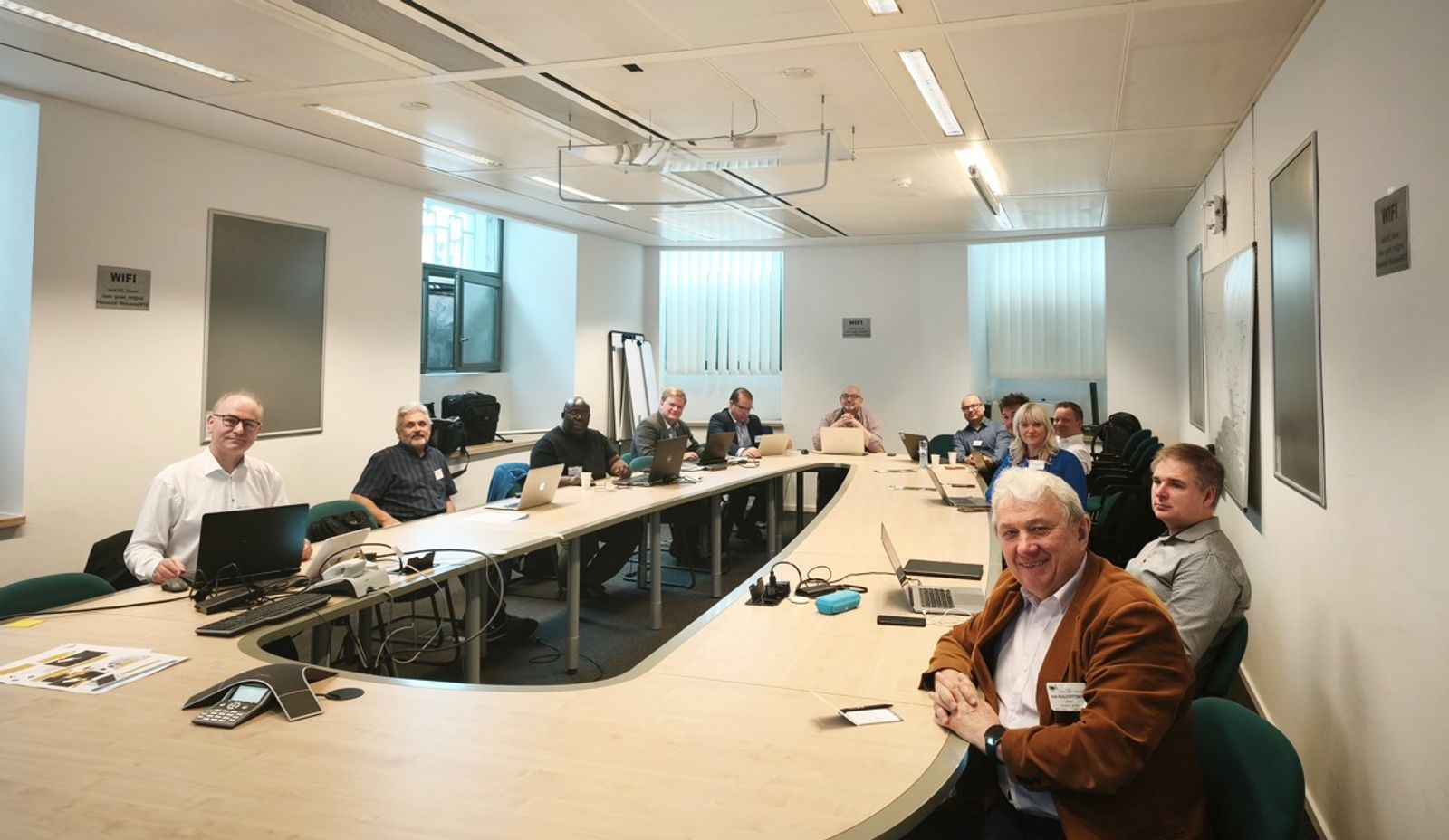
The SimuLingua consortium held an official kick-off meeting at the European Commission’s CDMA building on June 15, 2026.
During the kick-off meeting, Project Coordinator Per Kjellgren (FLOWPHYS AS) presented the project vision: to develop an open, multimodal Scientific Foundation Model for materials that integrates language, structure, image, and simulation data. The project will combine open-source AI methods with physics-informed simulations to support more efficient and transparent materials research.
The kick-off included technical discussions on the project’s main pillars: multimodal knowledge graphs, AI-accelerated simulation workflows, and validation across six use cases. These activities will support the development of a FAIR, reproducible, and scalable platform for materials discovery.
The consortium also participated in a joint session on 16 June 2026 with other Horizon Europe projects under the GenAI4EU initiative, contributing to the wider European effort to strengthen foundation models for science.
Launch social media channels
SimuLingua uses three social media channels to disseminate information about the project:
LinkedIn Page — https://www.linkedin.com/company/simulingua
X.com — https://x.com/SimuLingua
YouTube channel — https://www.youtube.com/@SimuLingua-1
We invite you to follow the project’s news on these social media platforms.
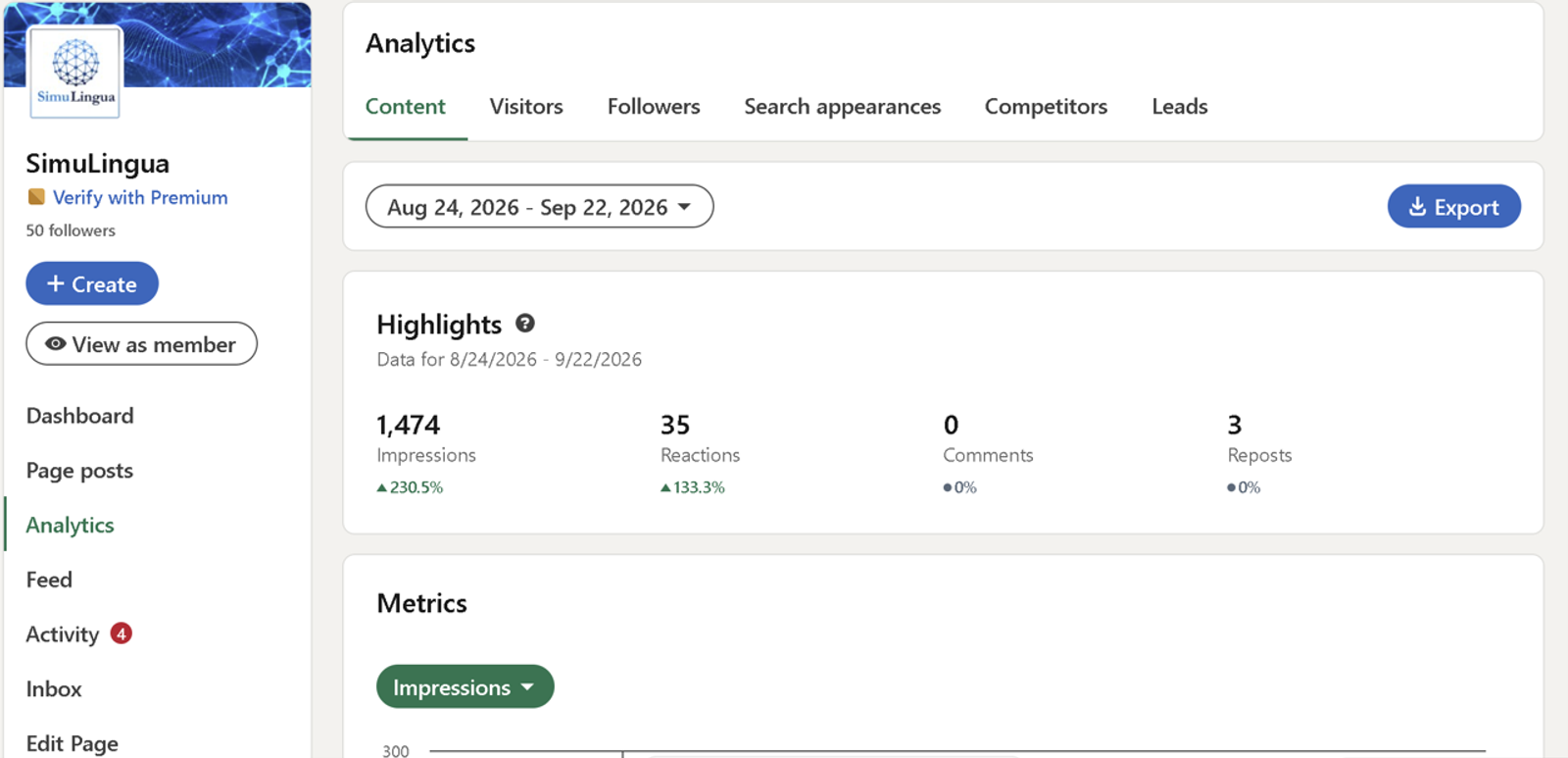
The project’s LinkedIn page already has 50 followers.
Launch project website
Link to the website: https://simulingua.eu/
The consortium announced a new project website on 10 August 2026.
AEI prepared the deliverable D18.2: ‘Project Website and Communication Materials’ https://simulingua.eu/library/deliverables
The website’s main menu consists of 8 sections.

The information on the website is updated regularly.
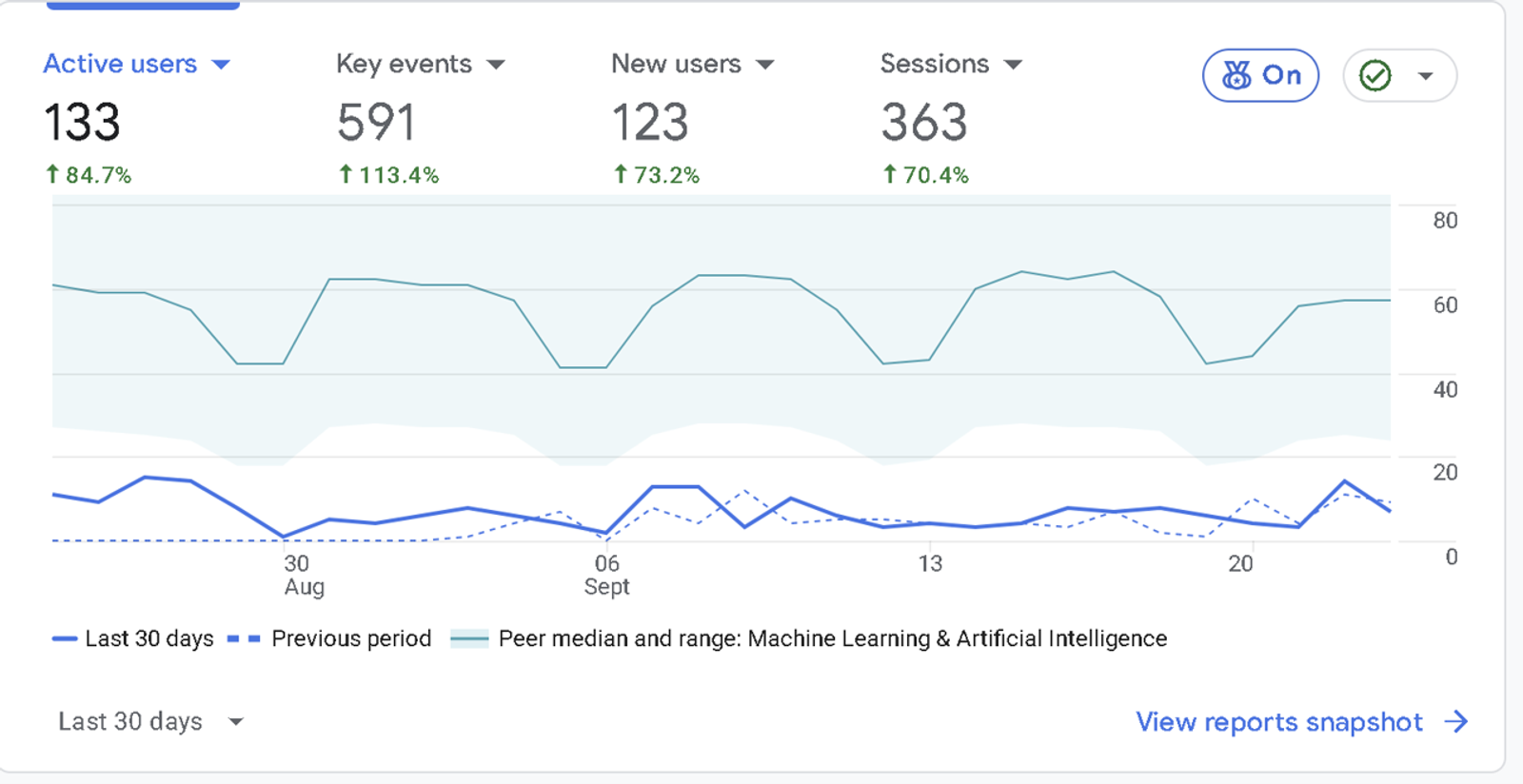
The statistics in the images below indicate that the project’s website has 123 newvisitors during the last 30 days.
First promotional flyer
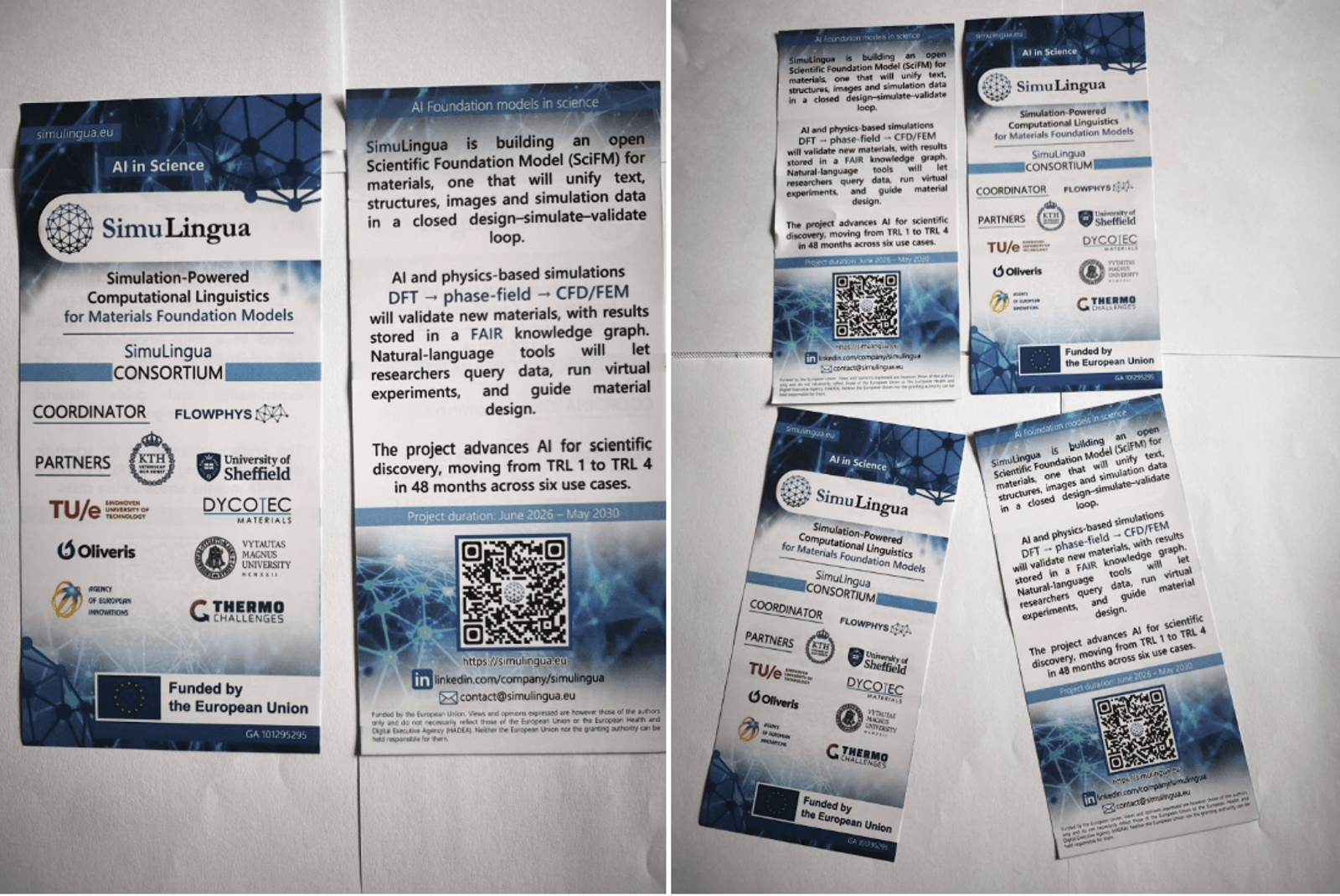
AEI, in collaboration with the project coordinator, has produced the project’s first flyer, which will be distributed in both digital and printed formats.
The digital version of the flyer can be downloaded here: https://simulingua.eu/library/promo
First two monthly consortium meetings
SimuLingua consortium held two online working meetings on M3 (August 11, 2026) and M4 (September 8, 2026).
The SimuLingua project has successfully transitioned from its initial planning stages firmly into the active implementation phase.
Here is a summary of the progress and key outcomes from both meetings:
The consortium shifted focus from administrative setup to concrete technical execution. Technical work packages (including WP7 and WP10) are now fully active, key personnel have been onboarded, and the first official deliverable (D18.2: project website and communication materials) has been completed and submitted. Furthermore, the Technical and Commercial Advisory Boards were successfully established.
Key Technical Progress & Work Package Updates:
- Data Extraction & "Data Factory" (FPS & UoS): UoS completed a manual data extraction pipeline for electroceramics, successfully processing 31 foundational papers into a 60-column schema for piezoelectric properties. Building on this, FPS developed and deployed an automated "Data Factory" tool to streamline data extraction from literature, which is now being tested across all project use cases.
- Knowledge Graph & Foundation Model (TU/e - WP4 & WP7): TU/e successfully onboarded two postdoctoral researchers—a computational chemist and a computer scientist. They have established a clear technical roadmap that moves from identifying scientific problems toward running initial local experiments in preparation for the M12 foundation model release.
- High Entropy Alloys (KTH): KTH completed a review of data sources for refractory High Entropy Alloys (HEAs). Finding public databases lacking, they identified rich datasets in published literature (over 5,500 refractory compositions) and established CSV as the standard interchange format for the project's multimodal data pipeline.
- Legal & Ethical Compliance (VDU): VDU actively aligned the project's data gathering with the EU AI Act, preparing integrated legal and ethical questionnaires for partners to ensure data ingestion (such as trade secrets and copyrighted materials) remains compliant as the project moves outside a controlled lab environment.
The consortium has also established a strict monthly cadence for presenting technical results, ensuring momentum is maintained as the partners work toward the first substantial technical deliverables and the release of the first foundation model at Month 12.
Presenting the project at international events
SimuLingua was presented at the 12th International Conference on Material Science & Smart Materials (MSSM 2026), held 2–4 September at the National and Kapodistrian University of Athens. The hybrid meeting brings together researchers and practitioners working on characterisation, design, manufacturing and application of materials.
On Day 2, Per Kjellgren — Founder and Technical Director of Flowphys AS and coordinator of the Horizon Europe action — gave a keynote titled “SimuLingua: An AI Foundation Model for Materials Science”. The talk introduced the project to the materials community it is built to serve, a few months after kick-off on 15 June 2026.
SimuLingua — Simulation-Powered Computational Linguistics for Materials Foundation Models — is a 48-month Research and Innovation Action under GenAI4EU (HORIZON-CL4-INDUSTRY-2025-01-DIGITAL-61; GA 101295295). Flowphys coordinates a nine-partner consortium from Norway, Sweden, the United Kingdom, the Netherlands, Ireland, Lithuania and Ukraine. The project is developing an open multimodal Scientific Foundation Model that integrates chemical formulas, simulation data, microstructures, crystal graphs, and scientific literature, then couples proposals to a physics-in-the-loop pipeline and a FAIR knowledge graph.
Taking the project to an application-facing materials conference, rather than only an AI or digital-industry forum, is deliberate. The researchers who will later query the model in natural language, discard an unsynthesisable candidate, or rerun a cladding or melt-pool case sit in that audience. MSSM 2026 is one of the first major materials meetings after the consortium started work.
More information on the keynote and Flowphys’s role in the consortium is on the coordinator’s news page.